Priority cache is ready
Stran zdaj bere že shranjene rezultate iz baze, zato je odzivna. Rebuild v ozadju uporabi, ko želiš osvežiti Pareto-kompromisni izbor za trenutno filtriran nabor.
Trypanothione reductase (TryR / TR) · T17
Trypanosoma brucei
PDB 5S9T
Why selected: Genetically and chemically validated antiparasitic target with multiple
ligandable pockets beyond the canonical cofactor site.
Targets
1
each capped at 50 ligands
Best-pose candidates
1369
one best pose per ligand per target
Synth metric
SA score
direct SA metric
Absolute burial proxy
n_exposed
absolute exposed hydrophobic atoms, not fraction
Pareto front 1
6
non-dominated ligands across all selected targets
Burial source
FreeSASA 0
Proxy 0 · Missing 4
T17
Native
Front 1: 6
50 / 1369 shortlisted
Best: OHD_TbNat_133 · score 54.2
Pareto layers observed: 13
| Target | 2D | Rank | Pareto | Ligand | Compromise | Docking | Final rank | Inter norm | n_exposed | Strain dE | MW | cLogP | TPSA | SA score | Safety | Native sim | PAINS | Reactive | QED | SASA source | Flags | |
|---|---|---|---|---|---|---|---|---|---|---|---|---|---|---|---|---|---|---|---|---|---|---|
| T17 T17 |
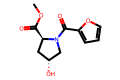
|
1 | 1 Front 1 (non-dominated) |
5S9T
well-buried hydrophobics, native-like contacts, clean safety profile
MW 239.2 · logP 0.03 · TPSA 80.0
|
54.2 | 0.00 | - | - | 1 | - | 239.2 | 0.03 | 80.0 | 2.992 | 0.76 | 1.00 | 0 | 0 | 0.74 |
Not available
FreeSASA was expected, but no SASA metrics were cached for this pose.
|
Native reference ligand
|
|
| T17 T17 |
|
2 | 1 Front 1 (non-dominated) |
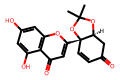
OHD_TbNat_133
strong docking, well-buried hydrophobics
MW 344.3 · logP 2.08 · TPSA 106.2
|
52.1 | 0.75 | 3.3492 | -0.7863 | 0 | 13.67 | 344.3 | 2.08 | 106.2 | 4.172 | 0.55 | 0.34 | 0 | 0 | 0.82 |
Not available
FreeSASA was expected, but no SASA metrics were cached for this pose.
|
Geometry warning, geometry warning; 8 clashes; 7 protein contact clashes; moderate strain Δ 13.7
|
|
| T17 T17 |
|
4 | 1 Front 1 (non-dominated) |
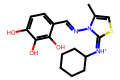
Z56920485
strong docking
MW 348.4 · logP 1.17 · TPSA 92.0
|
40.7 | 0.78 | 3.8182 | -0.8084 | 8 | 29.87 | 348.4 | 1.17 | 92.0 | 3.762 | 0.61 | 0.15 | 0 | 0 | 0.50 |
Not available
FreeSASA was expected, but no SASA metrics were cached for this pose.
|
Geometry warning, geometry warning; 8 clashes; 5 protein contact clashes; high strain Δ 29.9
|
|
| T17 T17 |
|
5 | 1 Front 1 (non-dominated) |
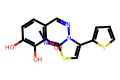
Z56911531
strong docking, reasonable synthesis profile
MW 347.4 · logP 2.81 · TPSA 90.3
|
35.4 | 0.79 | 5.5303 | -0.8785 | 10 | 32.43 | 347.4 | 2.81 | 90.3 | 2.994 | 0.41 | 0.20 | 0 | 0 | 0.50 |
Not available
FreeSASA was expected, but no SASA metrics were cached for this pose.
|
Geometry warning, geometry warning; 6 clashes; 12 protein contact clashes; high strain Δ 32.4
|
How to build the score
Docking 28% · final rank, interaction-normalized score, raw docking score
Burial 18% · absolute exposed hydrophobic atom count (lower is better)
Strain 14% · strain delta, intra score, geometry sanity
Safety / EcoTox 18% · ADMET plus ecotox, reweighted toward cleaner liabilities
Synthesis 10% · SA score when available, otherwise Fsp3 proxy
Native similarity 12% · contact and H-bond recall when a native reference exists
How ranking works: first we build Pareto fronts from docking, burial, strain, safety/ecotox, synthesizability, and native-like interactions. Front 1 contains non-dominated ligands, meaning no other ligand is better in all tracked objectives at once. Inside each front, ligands are ordered by a compromise score, which is a weighted desirability score with explicit penalties for PAINS, reactivity, toxicity alerts, geometry warnings, excluded poses, and artifact annotations. The top 50 per target are then taken front-by-front; if the cut falls inside one front, the compromise score decides the boundary.
Methodology
1. Candidate definition. For each target we keep one best pose per ligand, so the shortlist is not inflated by many similar poses of the same compound.
2. Objective set. Each ligand is evaluated across docking quality, absolute nonpolar solvent exposure (`n_exposed`), conformational strain, native-like interaction similarity when a native reference exists, safety and ecotoxicology, synthesizability, and general developability indicators such as QED.
2a. SASA / burial source. The new `SASA source` column tells you whether burial-sensitive surface metrics were computed from `FreeSASA` (`FreeSASA`), approximated only from the contact-based exposure proxy because no surface calculation was possible (`Proxy only`), or expected but still unavailable (`Not available`). Pareto ranking still uses the absolute `n_exposed` burial proxy everywhere, but `FreeSASA` gives extra physical context for how trustworthy the burial picture is.
3. Liability penalties. PAINS motifs, reactive groups, toxicity alerts, artifact annotations, geometry warnings, and excluded-pose flags do not automatically remove a ligand, but they reduce its compromise score and are exposed explicitly in the table.
4. Pareto ranking. A ligand is placed on Pareto front 1 when no other ligand for the same target is better across all tracked objectives at once. Lower front number means a more balanced profile, not just a stronger docking score.
5. Compromise score. Inside each Pareto front we apply a weighted desirability score to prioritize practical ligands. The current formula is `100 x clamp(weighted positive score - liability penalty - missing-data penalty)`, where the weighted positive score uses docking `28%`, burial `18%`, strain `14%`, safety/ecotox `18%`, synthesis `10%`, and native similarity `12%` when a native reference exists.
6. Component details. The docking component itself is a weighted mix of `final_rank_score` `55%`, `score_inter_norm` `30%`, and raw docking `score` `15%`. Strain combines `strain_delta` `55%`, `score_intra_norm` `30%`, and geometry sanity `15%`. Liability penalties are then added for PAINS, reactivity, toxicity alerts, excluded poses, artifact flags, and failed geometry checks.
7. SA score / SA column. This column shows the raw synthesis-related metric stored for the ligand. When a direct SA score is available, it is preferred; otherwise a proxy fallback is used. The table shows that raw value for transparency, but ranking uses the normalized `synth_component`, so the compromise score always interprets a better synthesis profile as a higher contribution.
8. Final shortlist. The top 50 ligands per target are taken front-by-front. If the cutoff falls inside one front, the compromise score determines which ligands stay in the visible shortlist.
How to read the table. `Pareto` shows the non-dominated layer, `Compromise` is the within-front ordering score, `n_exposed` is an absolute burial proxy where lower is better, `Strain dE` captures conformational stress, and the colored dots provide a quick green/orange/red cue for each property.
How to use selections. You can mark compounds row-by-row, save them into `Current`, `Temp`, or global sets `A/B/C`, export them to `SDF`, `XLSX`, or `CSV`, and send the selected subset straight into downstream analysis pages for histograms, projections, and other exploratory views.